Mariana S. Țăranu
In February 1947, Onisim Budacov, a priest from Băcioi, explained in a petition that he had been forced to buy maize to fulfil his obligation to deliver 450 kilograms to the state, although his own household's harvest was insufficient. In March, he asked the authorities to allow him to purchase 15 poods of grain or flour at the state price. He was not seeking a privilege: he was trying to save his family from hunger. These documents appear in the collection I edited, Un genocid nerecunoscut (“An Unrecognised Genocide”). They raise a fundamental question: how does a person come to buy food to surrender it to the state, and then have to ask permission to buy food to survive? [2, pp. 48–51]
This is the starting point of my research. Famine cannot be explained solely by the quantity of grain produced. We must examine who controlled food, who decided how it was distributed, and what happened to people who could no longer meet the obligations imposed on them.
Drought explains scarcity. Political decisions explain starvation
War, losses sustained by households, and the drought of 1945–1946 created a grave situation. I neither deny these factors nor exclude them from the explanation. But acknowledging them does not complete the inquiry. The decisive question is what the Soviet authorities did as the population's resources ran out.
By Bessarabia, I mean here the historical region to which the communities studied belonged. The documents' principal administrative setting is the Moldavian SSR; these territorial boundaries are not identical.
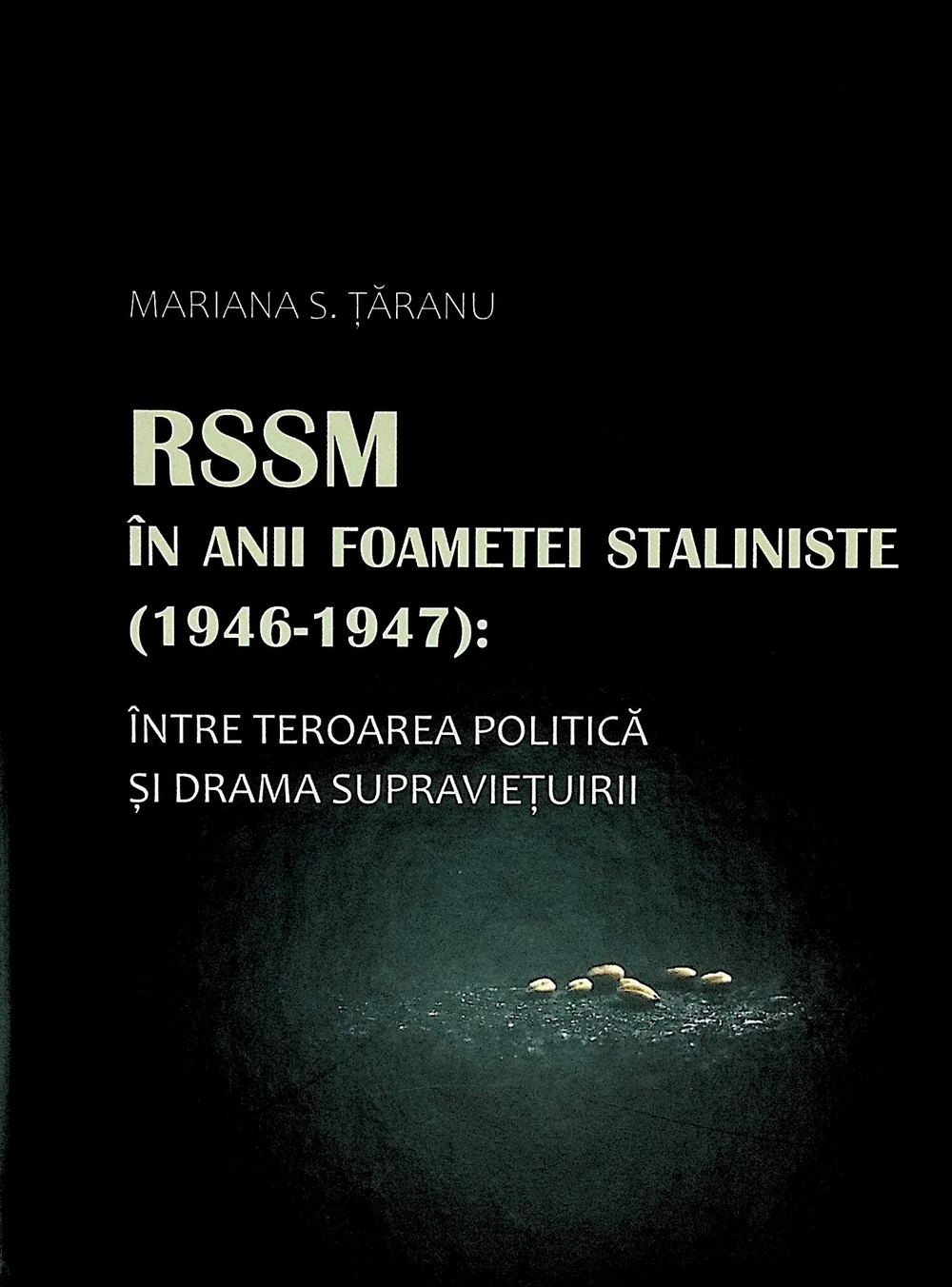
In RSSM în anii foametei staliniste (1946–1947): între teroarea politică și drama supraviețuirii (“The Moldavian SSR during the Stalinist Famine: Between Political Terror and the Struggle for Survival”), I argue that state policy transformed an agricultural crisis into a catastrophe. Requisitions, fiscal coercion, and control over access to food made famine an instrument for subordinating society. In my interpretation, starvation must be investigated as part of Sovietisation, rather than as an accident outside that process. [1, pp. 7–8, 44–68, 128–138]
My dialogue with other researchers begins here. Michael Ellman regards the Soviet famine of 1947 as preventable: drought reduced food availability, but different government priorities could have prevented or diminished the famine. [5] This perspective supports my inquiry into responsibility for decisions, beyond the observation that the harvest was poor.
Nicholas Ganson places the famine within multiple causes, ranging from the consequences of war to Soviet political and ideological choices. [6] I accept the need for this context. But multiple causes must not dissolve responsibility: we must identify the constraints that existed and the decisions that could have been changed.
The state demanded food that households did not possess
The mechanism of starvation did not emerge in a single day. It developed through rules that separated delivery obligations from households' actual capacity to meet them.
In my monograph, I examine the resolution of 21 April 1944 requiring deliveries of meat and eggs even from households without livestock or poultry. Grain delivery regulations tied obligations to agricultural acreage, rather than simply to the harvest actually obtained. Certain categories qualified for exemptions; these did not, however, alter the system's general logic. [1, pp. 44–48]
The consequence could be the situation Budacov described: to meet an obligation, a person had to buy a product they did not have. When the harvest was insufficient, this rule consumed the family's remaining resources.
Documents on the enforcement of procurement show the involvement of district and village authorities, activists, and local organisations. We are discussing more than a target entered in a table: we must understand how that target reached into the household. [1, pp. 55–59]
Eufrosinia Sumnevici of Ișnovăț recalled that in 1946, after searching the attic, cellar, and barn, collectors found a barrel of sunflower seeds hidden among maize stalks and took it away, although the family had six children. This is retrospective testimony, published in 1991. I use it alongside administrative documents to reconstruct the experience of enforcement, not as a replacement for those documents. [1, p. 55]
Petitions reveal what reports cannot contain
Letters to the authorities have particular value. Their authors expressed suffering in language through which they hoped to secure official intervention. A petition must therefore be read both for the information it contains and for the constraints under which it was written.
Budacov did not openly challenge the entire system. He sought access to food within it. This very limitation makes the document significant: a hungry family needed authorisation to buy grain at an affordable price. His petitions of February and March 1947 were also published in Scrisori către Stalin sau spovedaniile celor ocupați (1947–1953) (“Letters to Stalin, or the Confessions of Those under Occupation”), before being reproduced in Un genocid nerecunoscut. [2, pp. 48–51; 3]
For me, these letters restore people's names and their attempts to act for their own survival. They also show how deeply power penetrated everyday life: survival itself became the subject of an administrative request.
Relief existed. Who could obtain it?
A rigorous argument must include the records of relief. In August 1946, food loans were granted, repayable from subsequent harvests, and procurement targets were reduced. Further interventions followed in 1947. I do not argue that the authorities provided no assistance. I examine its timing, conditions, distribution, and effects. [1, pp. 98–105]
A document from January 1947 concerning Congaz provided for a delegation tasked with combating dystrophy to receive 15 kilograms of animal fats, 15 of honey, and 10 of cheese from reserve funds, at cost price. It shows a supply channel serving an official mission. It does not prove that reserves were sufficient for the entire population, but it requires us to investigate unequal access to food. [2, pp. 51–52]
At the other end of distribution was the hungry child. In my monograph, I reproduce Petru Bulai's testimony from Caplani: his mother carried him to a canteen, but the child was initially absent from the lists. After he was registered, she waited until everyone had received their portion; if food remained, she could eat too. Otherwise, the mother returned home hungry. [1, p. 100]
These sources require us to distinguish between an allocation, food delivered to a locality, and a meal actually received by someone in need. Administratively recorded relief cannot be assessed solely through the resolution announcing it.
Igor Cașu has emphasised the Soviet leadership's responsibility, Stalin's knowledge, and the fact that assistance does not cancel responsibility for the catastrophe. [4] Our research converges here. My contribution seeks to reconstruct the mechanism at the level of the household, village, and survivor.
Starvation as an instrument of subordination
In Un genocid nerecunoscut, I explicitly presented my interpretation of the organised famine as genocide. This position requires demonstration, not repetition of a label. Records of food extraction, knowledge of suffering, and insufficient or uneven relief must be analysed together. My argument concerns the use of starvation in political and social subordination; I do not reduce it to the existence of a single extermination order. [2, pp. 15–18; 1, pp. 128–138]
Precision with numbers is also essential. In my monograph, the estimate of 20–25% refers to direct and indirect victims, not to an established percentage of deaths. I will not use these categories interchangeably. The number of people who died, the number affected, and the number of families whose lives were disrupted are different questions requiring distinct criteria and sources. [1, p. 135]
These are the issues I wish to discuss with other historians: what the documents demonstrate about intent, how responsibility can be established, and how the scale of losses can be reconstructed. Agreement and disagreement become productive when they address sources and the steps of an argument.
To investigate famine is to explain power
Budacov's petition, compulsory deliveries, and the testimony of a child carried to a canteen belong to the same history. Together, they show how control over food could make a person dependent on the state.
That is why I argue that the famine of 1946–1947 must be understood within the history of Soviet domination over Bessarabia. Drought reduced resources. The authorities decided what to take, what to leave, and who could access what remained.
In RSSM în anii foametei staliniste, I develop this explanation of the political and administrative mechanism. Un genocid nerecunoscut presents documents and testimonies, while Scrisori către Stalin allows readers to trace the relationship between people under occupation and the authority they petitioned. These books provide the foundation for the research I will continue here: an evidenced history of Soviet repression in which documents, survivors' voices, and debate among historians test one another.
References
[1] Mariana S. Țăranu, RSSM în anii foametei staliniste (1946–1947): între teroarea politică și drama supraviețuirii, Chișinău, Lexon-Prim, 2026. ISBN 978-9975-181-42-6. Ediția consultată: 148 p.
[2] Mariana S. Țăranu (editor), Un genocid nerecunoscut, București, Editura Vremea, 2020. Ediția consultată: 234 p. Pentru petițiile lui Onisim Budacov: documentul nr. 7, pp. 48–51. Pentru delegația de la Congaz: documentul nr. 8, pp. 51–52; cota indicată în ediție: AOSPRM, F. 27, inv. 1, dos. 62, f. 34.
[3] Mariana S. Țăranu (editor), Scrisori către Stalin sau spovedaniile celor ocupați (1947–1953), Chișinău, Pontos, 2014. Petițiile lui Budacov: pp. 199–201, potrivit trimiterilor din [2], pp. 48–51; articolul utilizează transcrierile consultate în [2].
[4] Igor Cașu, A Moldavian Holodomor? The Great Famine in Soviet Moldova, 1946–1947, rezumatul conferinței, Stanford CREEES, 17 mai 2016. https://creees.stanford.edu/events/moldavian-holodomor-great-famine-soviet-moldova-1946-1947
[5] Michael Ellman, „The 1947 Soviet Famine and the Entitlement Approach to Famines”, Cambridge Journal of Economics, 24, nr. 5, 2000, pp. 603–630. DOI: https://doi.org/10.1093/cje/24.5.603. Rezumat și date bibliografice: https://dare.uva.nl/id/95b8db4c-56a8-40b3-af21-fedc7b1779af
[6] Nicholas Ganson, The Soviet Famine of 1946–47 in Global and Historical Perspective, New York, Palgrave Macmillan, 2009. DOI: https://doi.org/10.1057/9780230620964. Prezentarea editorială a argumentului: https://link.springer.com/book/10.1057/9780230620964